Ten years of therapy in one week
The Hoffman Process
“Remember one basic thing: unless the pattern of your mind is thrown away, unless you are ‘de-patterned,’ unless your conditioning is thrown away and you are deconditioned, you will not know what reality is—you will know only interpretations.”
— Osho“What matters is to understand for oneself, not through the direction of others, the total content of consciousness, which is conditioned, which is the result of society, of religion, of various impacts, impressions, memories—to understand all that conditioning and be free of it. But there is no ‘how’ to be free.”
— Jiddu Krishnamurti“One believes things because one has been conditioned to believe them.”
— Aldous Huxley, Brave New World
I’ve recently come to believe that you are not truly an adult until you understand how you were conditioned in your childhood and teenage years. Most of this conditioning happens subconsciously or at a level of perception below what’s visible for you to notice in yourself. But it’s the most impactful self-awareness for understanding why you think the way you think, feel the way you feel, and behave the way you behave in all your relationships.
I recently attended the Hoffman process, which targets this conditioning, and wanted to share my experience for the benefit of others.
The origins and track record
The Hoffman Process began in 1967 when Bob Hoffman, a tailor from Oakland, California, developed this approach after his own struggles with depression and relationship patterns. What started as one man’s journey to understand his conditioning has grown into a global program operating in 14 countries. Over 135,000 people have completed the process in nearly 60 years.
A UC Davis study tracking alumni found that 95% would recommend the process to a friend. Six months after completing Hoffman, participants report an average 25% increase in emotional well-being scores and a 40% reduction in anxiety levels.
The Process makes you aware of all the ways you were conditioned by your parents and/or surrogate parents. It then shows you how you play out all of that conditioning in your other relationships—and why that’s something you want to have choice over.
How I would describe the benefits
- Ten years of therapy in one week
- The most impactful self-development work I’ve ever done
- The greatest gift you could give yourself, your parents, your close relationships, and your future children
- What I hadn’t yet found in the outside world through external markers of validation, I found in Hoffman
- A new beginning; a heightened state of maturity and consciousness
- A pathway to understanding my spirit (with no religious connotations)
- A pathway to understanding all parts of myself
- An opportunity to release all my anger, shame, and vindictiveness from the past
How I felt when leaving Hoffman
- Like I wasn’t running from myself anymore
- Like I’d found home
- Like I was “ready”
- Like I was no longer scared
- Like I can truly ‘live’ now
- Unconditional self-love: the type that is felt, not thought about or known merely as an intellectual concept
- Deep compassion and forgiveness for my parents—or lack thereof
- Renewed; like I was starting a new life
- Like I had discovered the secrets to most human behavior
- A newfound, deep respect for the sensitivity and responsibility of parenting
How does it work?
The retreat is intentionally immersive: eight days with no phones, no internet, and activities running from 8 AM to 9 PM. Confidentiality is paramount—you’re not supposed to attend with anyone you know, and participants aren’t even allowed to discuss their work.
In my group of 24, there were entrepreneurs, doctors, lawyers, nutritionists, etc. I was one of the youngest there, with most being in their 30s/40s/50s, some getting divorced, others with young children. People I probably would never have connected with in normal life, yet I found myself more open with them than friends I’ve known for decades.
Each part of the process is conducted using a combination of the following formats:
- Seminar talks
- Group discussion
- Silence
- One-on-one discussions with facilitators
- Visualizations
- Meditations
- Writing
- Physical expression
- Verbal expression
This section is intentionally ‘light-on’ because I don’t want to share what is better experienced first-hand.
The cycle of transformation
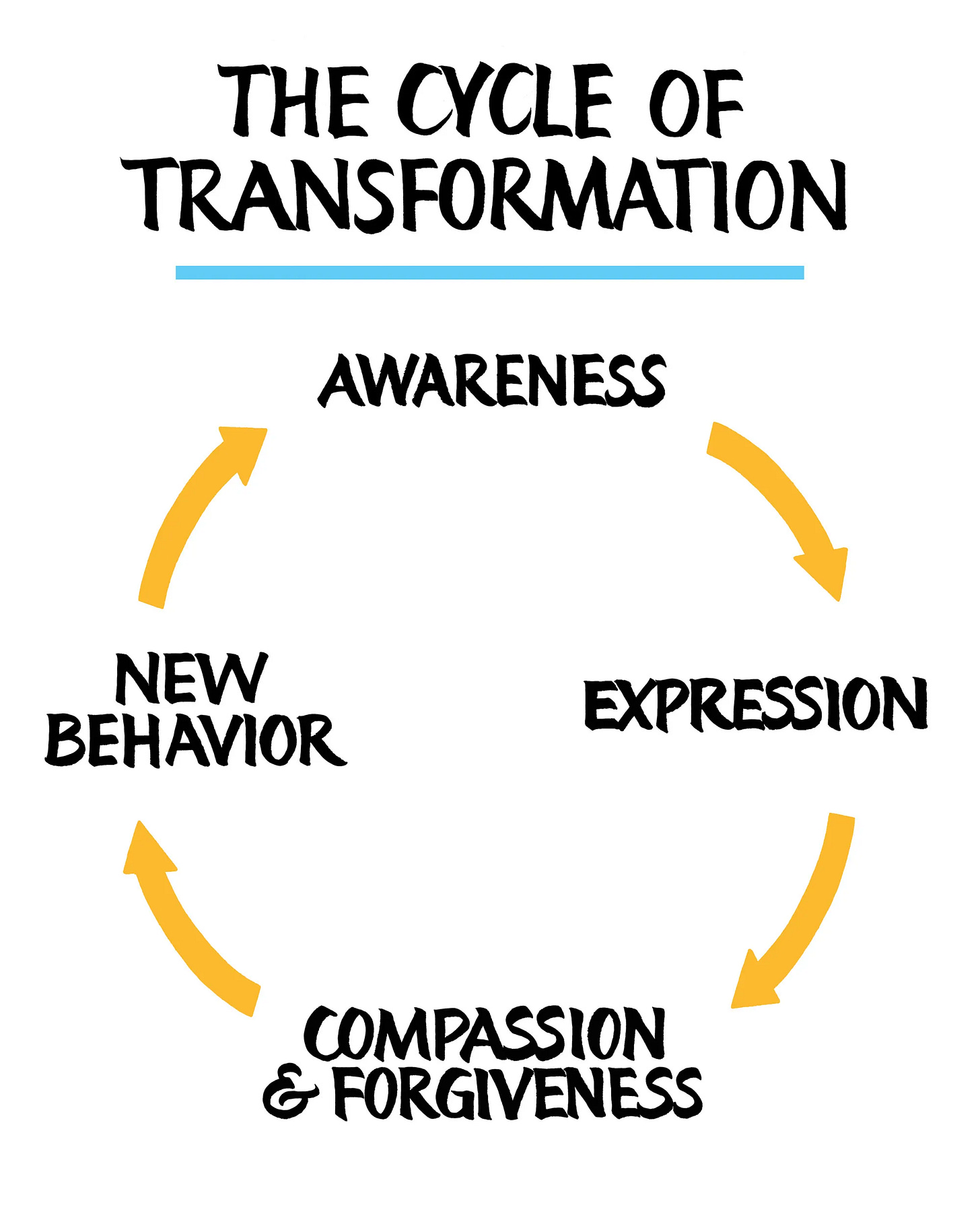
What I will share is that the process is split into four key stages:
- Awareness: Recognizing the unconscious patterns and conditioning from childhood that drive your current thoughts, feelings, and behaviors.
- Expression: Safely releasing the suppressed emotions and unmet needs from your past through various physical, verbal, and creative outlets.
- Compassion & Forgiveness: Developing understanding and empathy for both yourself and your parents, seeing them as flawed humans doing their best with their own conditioning.
- New Behavior: Consciously choosing how to respond in relationships based on your authentic self rather than automatic, conditioned reactions.
A crucial aspect of the process is “surrendering” fully to it. That means accepting and engaging completely in each activity, but also not trying to “control” or “prepare” too much.
One thing that initially frustrated me was not knowing the agenda beforehand. I wanted to mentally prepare, to understand what I was walking into. But this uncertainty is intentional—they want you to lead with spirit rather than intellect, to show up open rather than prepared. This surrender of control becomes part of the transformation itself.
Being present is key, so the facilitators advise you not to read ahead once you’re given your booklet with the eight days of activities. I recommend following this advice. I attended Hoffman somewhat spontaneously on a friend’s recommendation and didn’t form any strong preconceptions beforehand. I had a hunch it was what I needed, but I was surprised to find out that it was indeed exactly what I needed—and more. I think this allowed me to get full value from the process.
In isolation, if I told you some of the activities, you would likely laugh and say, “That sounds crazy.” But in the context of the process, everything makes sense and has been constructed intentionally over the 60 years since Hoffman began.
Who would benefit?
Hoffman is non-discriminating in terms of who can and should attend. Everyone from orphaned children to single mothers to Fortune 500 CEOs attends. In my view, everyone would benefit from the knowledge in the process. If you ask me, it should be mandatory in the final year of schooling and for all new parents.
If you resonate with any of the following statements, it would probably benefit you most:
- “I feel like something’s missing in my life, even when things look successful on the outside”
- “I struggle with addiction, compulsions, or self-sabotaging habits”
- “I want to break free from negative self-talk or my inner critic”
- “I’m disconnected from my body or ignore physical signals”
- “My parent’s neglected my needs in some important way”
- “I keep repeating the same mistakes in my relationships”
- “I feel like I lack purpose or a deeper meaning in life”
- “I have trouble expressing my emotions or feel numb”
- “I’m running from something, but I don’t know what”
- “No matter what I achieve, I never feel like enough”
- “My parent(s) were more needy than I was”
- “I’ve never had mature adults in my life”
- “I avoid people for fear of getting hurt”
- “I’ve never truly felt unconditional love”
- “My parent’s love was conditional”
- “I struggle to trust other people”
- “I have a chip on my shoulder”
- “I persecute people”
- “I’m always angry”
- “I’m a rescuer”
- “I’m a victim”
A taster
I don’t want to ruin anyone’s experience by oversharing, but I will share one of my favorite parts of the process: Transference.
It’s the idea that:
“Wherever I go, whoever I see,
I see Mummy and Daddy,
And they see me too.”
In all of our relationships, professional or personal, we act in ways that were conditioned by our parents during childhood and teenage years. If you feel triggered by someone, it’s because that person has touched a deep wound that was likely first put there by a parent: rejection, neglect, isolation, insecurity, etc.
Here’s an example:
I get triggered when someone close to me makes excuses for why they can’t do something or why they haven’t done something. It causes me to go into what’s called a vicious cycle (in Hoffman terms) where you act out patterns (behaviors). For example:
- I feel weak and vulnerable because I feel like this person is unable to support even themselves, let alone others
- I go into a superiority mindset (“this person is weak,” “I’m better than them,” “I don’t want to be associated with weakness”)
- I feel impatient
- I withdraw or start dismissing them
But what’s really happening here is that I’m wearing glasses painted with a deep set of wounding experiences from childhood and teenage years, where my parents acted like this, and I formed protective behaviors to take back control. Clearly this is helpful in some contexts, but the important thing is that it’s a “conditioned” response. I don’t have choice over it occurring because it’s so deeply ingrained. There are many instances where someone would have a genuine reason for making an excuse, so it’s unhelpful for me to react the same way every time. I want to have choice.
The idea of transference is at the heart of the Hoffman process. It’s about becoming aware of your conditioned behaviors and learning to have choice over them. This choice provides full autonomy in your relationships.
“Between stimulus and response there is a space. In that space is our power to choose our response. In our response lies our growth and our freedom.”
— Viktor E. Frankl
Misc. insights, realisations, & learnings
I had too many realisations to name them all, but here is a sample of the most resonant during the process:
- Anger, when repressed, is resentment. Anger, like all emotions, is perfectly valid. It’s best to express it in a suitable way to avoid resentment.
- Negative ambition can only take you so far. At some point, you need to feel more connected to all beings and create from abundance.
- My life is still governed by phone usage—which becomes clear when you give it up for eight days. I must drastically reduce this.
- The story of the mother and father is embedded in the child. But it’s not fixed there.
- Shame forces us to reach for a role. The “caretaker,” the “responsible one,” “the golden child,” the “quiet achiever”
- What you see in someone is a compensation. What you see in someone is not what it’s about. It’s a consequence of what it was about.
- Your parents do not share the worst parts of their childhoods with you, nor do their parents share the worst with them. Therefore, their negative love was probably > yours. This helps with compassion for them.
- Parenting is the most sensitive job in the world.
Our spiritual selves is what lies beneath the ‘snow:’
To figure out who your spiritual self is, remove the patterns of the emotion child and intellect and ask:
- Spiritual self, who are you not?
- Spiritual self, who are you?
- The words that come to mind naturally are your true essence. When you’re living in alignment with these words is when you’re living to your spirit.
- When faced with difficult situations, ask, “What would my spirit do right now?”
- Not sharing needs is low risk, low return. When sharing needs, don’t “buy insurance.” Share what you need assertively but kindly without trying to rescue the other person.
- Everyone is in transference a great deal of the time. This explains a lot of human behaviour.
- Don’t ask yourself what the world needs: ask yourself what makes you come alive and then go and do that. Because what the world needs is people who have come alive.
- Most of people’s lives is driven by the need to please Mummy or Daddy or both. Figuring this out is the pathway to deconditioning.
- Unconditional self-love is the root of 80% of the benefit of the Hoffman process.
How Hoffman compares to other approaches
Hoffman vs. 10-Day Vipassana: Vipassana focuses on meditation and mindfulness over 10 days of silence. Hoffman is more interactive and relationship-focused, combining multiple therapeutic approaches. Vipassana develops awareness of thoughts and sensations; Hoffman specifically targets childhood conditioning.
Hoffman vs. Traditional Weekly Therapy: Traditional therapy happens gradually over months or years in one-hour sessions. Hoffman is intensive and immersive, designed to create rapid breakthroughs. Many therapists actually recommend Hoffman to accelerate their clients’ progress.
Hoffman vs. Weekend Workshops: Most personal development workshops are 2-3 days and focus on inspiration or skill-building. Hoffman’s eight days allow for deeper emotional processing and integration that shorter programs can’t achieve.
Start your own inquiry right now
You don’t need to wait for Hoffman to begin understanding your conditioning. Try journaling on these questions:
- When did I first feel I had to earn love? Think about specific moments when you learned that love was conditional on your behavior, achievements, or compliance.
- What patterns do I repeat in relationships? Notice if you tend to be the rescuer, the victim, the controller, or the people-pleaser across different relationships.
- What did I decide about myself as a child to survive my family environment? Perhaps you decided you had to be perfect, invisible, strong, or entertaining. These survival strategies often become lifelong patterns.
Spend 10 minutes writing on each question. You might be surprised by what comes up. These insights give you a taste of the deeper work Hoffman facilitates.
Next steps
If you’re curious about Hoffman, here are your best resources:
- Official website: hoffmaninstitute.org (international) or hoffmanprocess.com.au (Australia)
- The Book: “The Hoffman Process” by Tim Laurence gives a detailed overview of the concepts and exercises
- Podcast: Search for “Hoffman Process” interviews with graduates on platforms like Tim Ferriss or Rich Roll’s shows
The most important thing is to trust your gut. If something inside you is stirring as you read this, that’s probably your spirit telling you it’s time. I went into Hoffman on intuition rather than extensive research, and that openness served me well.
The process isn’t for everyone, and it’s not a magic cure. But for those ready to understand why they are the way they are—and to have choice over it—it might just change everything.